Bismillahirahmaniraheem
An interesting clip about terrorism. Saw my friend upload it and thought it is interesting to see it from a different point of view.

Thursday, 22 April 2010

Wednesday, 21 April 2010
Why Islamic Banking?
Bismillahirahmaniraheem
 Recently, I have encountered a few brothers discussing about Islamic banking and some don't really understand what Islamic banking is all about and they're having doubts about it. The doubts are to the extent where one brother believes Islamic banking is created to manipulate the people and create a new market. In this entry I will try and explain the historical evolution of Islamic banking to the extent of knowledge given to me.
"Those who devour interest, they behave as the one whom Satan has confounded with his touch seized in the state they say : " Buying and selling is but a kind of interest," even though Allah has made buying and selling lawful and interest unlawful. Hence he who receives this admonition from his Lord, and then gives up (dealing in interest), may keep his previous gains, and it will be for Allah to judge him. As for those who revert to it, they are the people of Fire and in it shall they abide." ( Surah al-Baqarah verse 275)
 Let us make a situation where one wants to buy a car. One buys a car through conventional banking and the car cost £5000. The person applies for a loan from the conventional banking to buy the car. The bank agrees to approve the loan of £5000and expect a repayment of £5000 plus the interest. Let's say the total of repayment after 3 years is £7000.
 Recently, I have encountered a few brothers discussing about Islamic banking and some don't really understand what Islamic banking is all about and they're having doubts about it. The doubts are to the extent where one brother believes Islamic banking is created to manipulate the people and create a new market. In this entry I will try and explain the historical evolution of Islamic banking to the extent of knowledge given to me.
Generally Islamic banking accepts almost all kind of transactions except any transactions that deals with riba(interest) and gharar(uncertainty). Why doesn't it accept riba(interest) and gharar(uncertainty)? The law is being extracted from the Holy Qur'an and the Sunnah/Hadith.
"Those who devour interest, they behave as the one whom Satan has confounded with his touch seized in the state they say : " Buying and selling is but a kind of interest," even though Allah has made buying and selling lawful and interest unlawful. Hence he who receives this admonition from his Lord, and then gives up (dealing in interest), may keep his previous gains, and it will be for Allah to judge him. As for those who revert to it, they are the people of Fire and in it shall they abide." ( Surah al-Baqarah verse 275)
"Allah will deprive usury of all blessing, but will give increase for deeds of charity: For he loveth not creatures ungrateful and wicked." (Surah al-Baqarah verse 276)
"Truly the reward of those who believe and do righteous deeds and establish Prayer and pay Zakah is with their Lord; they have no reason to entertain any fear or grief." (Surah al-Baqarah verse 277)
"O ye who believe! Fear Allah, and give up what all outstanding interest, if ye are indeed believers." (Surah al-Baqarah verse 278)
"If the debtor is in a difficulty, grant him time Till it is easy for him to repay. But if ye remit it by way of charity, that is best for you if ye only knew." (Surah al-Baqarah verse 280)
"O ye who believe! Devour not usury, doubled and multiplied; but fear Allah; that ye may (really ) prosper." (Surah al-Imran verse 130)
"That they took usury, through they were forbidden; and that they devoured men's substance wrongfully; we have prepared for those among them who reject faith a grevious punishment." (Surah al-Nisa verse 161)
"Whatever you pay as interest so that it may increase the wealth of people does not increase in the sight of Allah. As for Zakah that you give, seeking with it Allah's good pleasure, that is multiplied manifold. (Surah al-Rum verse 39)
The sequence of these revelation on riba thath came to our Prophet Muhammad Salallahu Alaihi Wassallam starts with the verse from Surah al-Rum, al-Nisa, al-Imran and al-Baqarah. Riba is understood by the Prophet Salallah Alaihi Wassallam and has taught us certain ways to avoid it through his sunnah ad hadith. Evolution has forced a lot of changes hence, riba also evolves. The important thing is that we have to understand riba and gharar and it is not something that people have created in recent times. The question here is, is it being conducted or practiced correctly?
Here are some verses from the bible on interest.
"If one of your countrymen becomes poor and is unable to support himself among you, help him as you would an alern or a temporary resident, so he can continue live among you. (36) Do not take interest of any kind from him, but fear your God, so that your countryman may continue to live among you. (37) You must not lend him money at interest or sell him food at a profit." (Leviticus 25:35-37)
(19)"Thou shalt not lend upon usury to thy brother; usury of money, usury of victuals, usury of any thing that is lent upon usury." (Deuteronomy 23:19)
"If thou lend money to any of my people that is poor by thee, thou shalt not be to him as and usurer, neither shalt thou lay upon him usury." (Exodus 22:25)
(35)"But love ye your enemies, and do good, and lend, hoping for nothing in return; and your reward shall be great, and ye shall be the children of the Highest: for he is kind unto the unthankful and to the evil." (Luke 6:35)
The followers of the bible have then understood these verses of prohibition on interest as; if a person is being oppressed of poor. They argue that it is permissible to charge interest to the rich or capable. John Calvin a precher in the 1500s claim that there is no problem on the interest as long as it doesn't bother the poor. I'm not going to through this in detail here.
So, conventional banking has no boundaries for it to be developed or evolve where else, Islamic banking has to be cautious on the development so that the prohibited will be avoided. Colonisation had an incredibly detriment affect on Islamic countries as noted by AbdelKader Chachi (2005). This occurred through disruption to the Islamic societies, which inevitably lead to Muslims being pushed away from the initial teachings of Islam. Subsequently, this leads to the stagnation in Islamic politics and economics, hindering the evolution of Islamic banking.
The recent Islamic banking industry is actually a mixture of conventional banking and the theoratical practices of Prohphet Muhammad within the constraints of permissible action which evade the prohibitions of interest and etc. For this reason, Islamic banking is always bound to have misconduct practices.
I am going to express my thought in interest. If one were to calculate for example £1 is borrowed at 5% interest in 1000 years, the new total would be £1,546,318,920,731,950,000,000. Look at the big difference! Logically no one would make a loan for 1000 years but a person would apply for a loan for thousands or millions of £ in a shorter time length. So my question is, is it fair to be paying and earning interest? Obviously, everyone is entitled to their opinion but my personal opinion is a definite NO. This is unfair because one can earn money without even doing anything.
 Let us make a situation where one wants to buy a car. One buys a car through conventional banking and the car cost £5000. The person applies for a loan from the conventional banking to buy the car. The bank agrees to approve the loan of £5000and expect a repayment of £5000 plus the interest. Let's say the total of repayment after 3 years is £7000.
The same situation but in Islamic banking. The person applies for a bank to buy the car for him and he will settle the payment with the bank in deferred payments. The bank agrees to buy the car for £5000 and sell it to the person for £7000 and the settlement is after 3 years. This transaction is called Murabaha, where the cost of the product and the profit margin is known to the client. Both have the same amount, so what is the difference?
In conventional banking, if a person misses a payment there is a recalculation of interest. The bank loans out the money to earn more money.
In Islamic banking, if the person miesses a payment, the same amount of payment still have to be carried out but the client may be charged a penalty and this penalty should not go to the bank but to a charity(this is a lengthy topic so I'm going to cut short). The bank actually buys the car from the supplier and delivers it to the client. In other words, the bank is conducting a trading. So the bank actually holds the risk where the bank has to deliver the car to the client and is responsible if anything happens to the car before it reaches the client, therefore the bank is entitled to earn some profit from the trading. There is a Hadith which says " Al kharaj bi al-dhaman" which means "no risk, no gain/reward/income/profit". Even though both look similar, but it is actually different. But do Islamic banks really conduct in this manner remain quesntionable. I hope this entry has given some exposure to everyone.
Wednesday, 14 April 2010
The importance of the Holy books
Bismillahirahmaniraheem

The Holy books were provided by Allah to His messengers as a guidance for the community at that certain point of time. Originally there was only one religion. As time passes by people got confused and therefore Allah sent His messengers and sent His words for the people to be guided back to the right path.
"And remember We gave Moses the Scripture and the Criterion (Between right and wrong): There was a chance for you to be guided aright." (Quran, Al-Baqarah verse 53)
"Mankind was one single nation, and Allah sent Messengers with glad tidings and warnings; and with them He sent the Book in truth, to judge between people in matters wherein they differed; but the People of the Book, after the clear Signs came to them, did not differ among themselves, except through selfish contumacy. Allah by His Grace Guided the believers to the Truth, concerning that wherein they differed. For Allah guided whom He will to a path that is straight." (Al-Baqarah, verse 213)
"Or do they envy mankind for what Allah hath given them of his bounty? but We had already given the people of Abraham the Book and Wisdom, and conferred upon them a great kingdom." (Al-Nisa, verse 54)
Who sets the guidance to mankind or to the community? If a ruler sets the law and the community as a whole agree on something to construct their law, it might be applicable only towards that community because of their tradition or customs. Since they are a community, it would be easier for them to accept the law. For example, it might be modest for a lady to wear a short skirt in Western culture but it might not be offensive for a lady to wear a short skirt in the Arab countries. Why is that so? Is it because of the customs and traditions? Is it because they follow the law from the Holy Quran? An ayah from the Quran mentions about ladies limitation on exposing their body in public. In Islam man also cannot exposed their body too much. It is understood that man are more physically capable to do labour work hence they are allowed to expose slightly more flesh compared to a lady. There is always a wisdom on why the body should not be over exposed. Our creator has warned us to not expose too much of our flesh/body. Certain community has accepeted and tries to adapt it as their custom. Many argues that the words in the Quran is made up by a human being (Prophet Muhammad Salallahu Alaihi Wassalam). If that is so, what benefit does it give to him to set such a law? Obviously it will not benefit him in any way by asking all mankind to do certain things. Since the law in the Quran is NOT 'man made' it is then made by the creator to suit and benefit ALL mankind.
Take for instance the news on French President Nikolas Sarkozy who called for a ban on hijab.
France have the estimated population of 5 million muslims and the interior ministry says JUST 1,900 women in France wear the full veils. The number might just be 1,900 and they are afraid that it might spread to the rest of the 5 million muslims. They are afraid to be labelled as an Islamic country rather than their proudly secularise government. Why not make it compulsory for every women to wear hijab? Hijab does not neccessarily represent Islam. Anyone can wear a hijab (headscarf) without being a muslim. (http://news.bbc.co.uk/1/hi/world/europe/8480161.stm)
Here are some ayah from the Quran about hijab.
“O you Children of Adam! We have bestowed on you raiment to cover your shame as well as to be an adornment to you. But the raiment of righteousness, that is the best. Such are among the Signs of Allah, that they may receive admonition.”(Surah al-A'raf verse 26)
"Say to the believing man that they should lower their gaze and guard their modesty; that will make for greater purity for them; and Allah is well acquainted with all that they do." (Surah Noor verse 30)
“And say to the believing women that they should lower their gaze and guard their modesty; that they should not display their beauty and ornaments except what must ordinarily appear therof; that they should draw their veils over their bosoms and not display their beauty except to their husbands, their fathers, their husbands' fathers, their sons, their husbands' sons, their brothers, or their brothers' sons or their sisters' sons, or their women or the servants whom their right hands possess, or male servants free of physical needs, or small children who have no sense of the shame of sex, and that they should not strike their feet in order to draw attention to their hidden ornaments. And O you Believers, turn you all together towards Allah, that you may attain Bliss.” (Surah Noor verse 31).
"Those who harass believing men and believing women undeservedly, bear (on themselves) a calumny and a grievous sin. O Prophet! Enjoin your wives, your daughters, and the wives of true believers that they should cast their outer garments over their persons (when abroad). That is most convenient, that they may be distinguished and not be harassed. And Allah is Oft-Forgiving, Most Merciful." ( Surah al-Azhab verse 58-59)
There's a tradition in Spain where they have a festival for throwing tomatoes everywhere. It might be acceptable in their country to do so. Imagine if that custom or tradition were being applied in a third world country; where food is insufficient. Of course people from the third world country will find it bizarre and would certainly not throw or waste the tomatoes. So who is entitled to guide mankind? A man? or Non other than our Eternal and All Knowing Creator?
These are only a few examples of why Quran is important. Insha'Allah this would be a step to open our mind and heart to accept each and every word sent to us to guide through our life. This is a reminder not just for the readers, but also a reminder to myself and my family.
This is a clip from the "tomato festival" in Spain from ITN
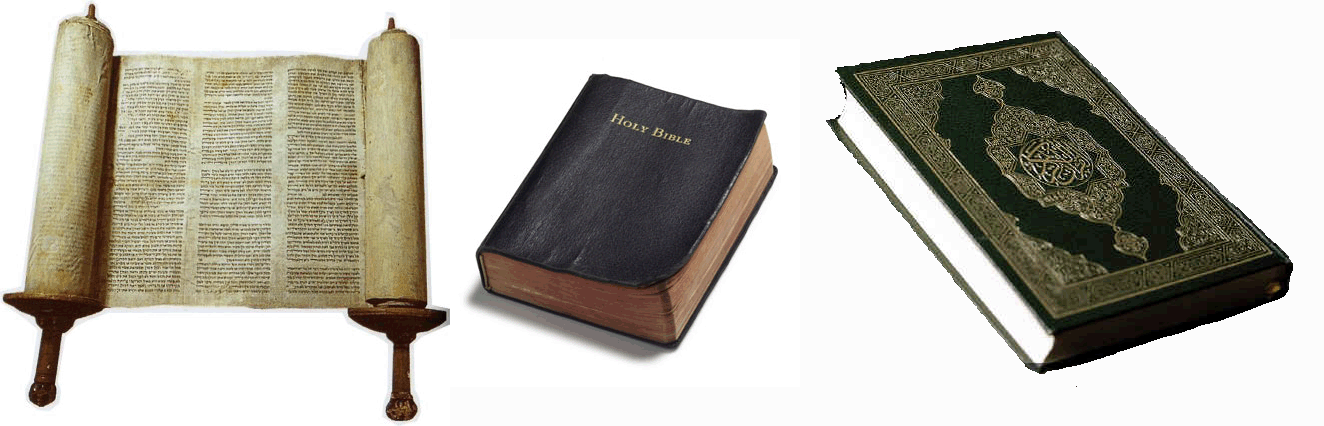
The Holy books were provided by Allah to His messengers as a guidance for the community at that certain point of time. Originally there was only one religion. As time passes by people got confused and therefore Allah sent His messengers and sent His words for the people to be guided back to the right path.
"And remember We gave Moses the Scripture and the Criterion (Between right and wrong): There was a chance for you to be guided aright." (Quran, Al-Baqarah verse 53)
"Mankind was one single nation, and Allah sent Messengers with glad tidings and warnings; and with them He sent the Book in truth, to judge between people in matters wherein they differed; but the People of the Book, after the clear Signs came to them, did not differ among themselves, except through selfish contumacy. Allah by His Grace Guided the believers to the Truth, concerning that wherein they differed. For Allah guided whom He will to a path that is straight." (Al-Baqarah, verse 213)
"Or do they envy mankind for what Allah hath given them of his bounty? but We had already given the people of Abraham the Book and Wisdom, and conferred upon them a great kingdom." (Al-Nisa, verse 54)
Who sets the guidance to mankind or to the community? If a ruler sets the law and the community as a whole agree on something to construct their law, it might be applicable only towards that community because of their tradition or customs. Since they are a community, it would be easier for them to accept the law. For example, it might be modest for a lady to wear a short skirt in Western culture but it might not be offensive for a lady to wear a short skirt in the Arab countries. Why is that so? Is it because of the customs and traditions? Is it because they follow the law from the Holy Quran? An ayah from the Quran mentions about ladies limitation on exposing their body in public. In Islam man also cannot exposed their body too much. It is understood that man are more physically capable to do labour work hence they are allowed to expose slightly more flesh compared to a lady. There is always a wisdom on why the body should not be over exposed. Our creator has warned us to not expose too much of our flesh/body. Certain community has accepeted and tries to adapt it as their custom. Many argues that the words in the Quran is made up by a human being (Prophet Muhammad Salallahu Alaihi Wassalam). If that is so, what benefit does it give to him to set such a law? Obviously it will not benefit him in any way by asking all mankind to do certain things. Since the law in the Quran is NOT 'man made' it is then made by the creator to suit and benefit ALL mankind.
Take for instance the news on French President Nikolas Sarkozy who called for a ban on hijab.

France have the estimated population of 5 million muslims and the interior ministry says JUST 1,900 women in France wear the full veils. The number might just be 1,900 and they are afraid that it might spread to the rest of the 5 million muslims. They are afraid to be labelled as an Islamic country rather than their proudly secularise government. Why not make it compulsory for every women to wear hijab? Hijab does not neccessarily represent Islam. Anyone can wear a hijab (headscarf) without being a muslim. (http://news.bbc.co.uk/1/hi/world/europe/8480161.stm)
Here are some ayah from the Quran about hijab.
“O you Children of Adam! We have bestowed on you raiment to cover your shame as well as to be an adornment to you. But the raiment of righteousness, that is the best. Such are among the Signs of Allah, that they may receive admonition.”(Surah al-A'raf verse 26)
"Say to the believing man that they should lower their gaze and guard their modesty; that will make for greater purity for them; and Allah is well acquainted with all that they do." (Surah Noor verse 30)
“And say to the believing women that they should lower their gaze and guard their modesty; that they should not display their beauty and ornaments except what must ordinarily appear therof; that they should draw their veils over their bosoms and not display their beauty except to their husbands, their fathers, their husbands' fathers, their sons, their husbands' sons, their brothers, or their brothers' sons or their sisters' sons, or their women or the servants whom their right hands possess, or male servants free of physical needs, or small children who have no sense of the shame of sex, and that they should not strike their feet in order to draw attention to their hidden ornaments. And O you Believers, turn you all together towards Allah, that you may attain Bliss.” (Surah Noor verse 31).
"Those who harass believing men and believing women undeservedly, bear (on themselves) a calumny and a grievous sin. O Prophet! Enjoin your wives, your daughters, and the wives of true believers that they should cast their outer garments over their persons (when abroad). That is most convenient, that they may be distinguished and not be harassed. And Allah is Oft-Forgiving, Most Merciful." ( Surah al-Azhab verse 58-59)
There's a tradition in Spain where they have a festival for throwing tomatoes everywhere. It might be acceptable in their country to do so. Imagine if that custom or tradition were being applied in a third world country; where food is insufficient. Of course people from the third world country will find it bizarre and would certainly not throw or waste the tomatoes. So who is entitled to guide mankind? A man? or Non other than our Eternal and All Knowing Creator?
These are only a few examples of why Quran is important. Insha'Allah this would be a step to open our mind and heart to accept each and every word sent to us to guide through our life. This is a reminder not just for the readers, but also a reminder to myself and my family.
This is a clip from the "tomato festival" in Spain from ITN
Tuesday, 6 April 2010
Gold and silver as Islamic money?

Bismillahirahmaniraheem
How would you respond to the claim that Islamic money is gold and silver and that Muslims should support an international return to the gold standard?

Money that is being dealt today has given us a lot of benefits and also giving us problems that are affecting most parts of the world with the financial crisis bubble burst. Comparison between gold or silver and fiat money or paper money will be done so that the pros and cons will easily be evaluated in the perspective of economics and Sharia’.
3) Islamic perspective on money
In the period of the rising of Islam, gold and silver was used as a common medium in trading. Most of the Arabs were businessman and traders, they were not known of craftsmanship so the Arabs dealings were always conducted in gold and silver as they have nothing else of significance in high demand to be used as money.
Early Muslim scholars considered gold and silver as the natural money or money by creation. Given that fiat money has replaced gold and silver, Muslim scholars have equated the modern fiat money with the jurist rules of gold and silver. Consequently, all kinds of prohibited interest or riba on gold and silver, as well as all conditions or requirements of zakah on gold and silver have been passed to fiat money.
There is not much being said in the Islamic perspective on gold and silver as generally Islam does not really endorse on the usage of gold and silver or even opposes on the usage of fiat money. There is a hadith by the Prophet salallah alaihu wassalam that interprets most miserable is the servant of Dirham and Dinar which emphasises on the usage of gold and silver which warns us on not to be obsessed in using gold and silver . It is undoubtedly that gold and silver may lead us astray due to its inherent value but it is a reminder for us so that we will not hesitate when spending gold and silver or money and always be a servant of Allah (god) rather than the servant of gold and silver.
If paper money was a debt of real wealth of gold and silver, it would not be allowed because of the prohibition from one of the Prophet’s Hadith about any transactions in gold, silver, wheat, barley, rice and dates is to be done on the spot and hand to hand. If the paper money represents gold, therefore this transaction goes against the hadith as the gold is not being transferred from one person to another.
 4) Fiat money
Generally, the value of money is determined by the law of supply and demand which has been said by Ricardo “the value of money is not determined by the labour time its substance embodies, but by the law of supply and demand only.” If money is being over produced but it is low on demand, the value of the money will depreciate tremendously. The United States of America
Generally fiat money will always be spent due to its specific purpose as a medium of exchange and because of its depreciating value. Time value for money will have an effect here, so people will tend to get rid of the fiat money in a shorter period compared to gold and silver. The disadvantage here is that when fiat money is over spent it will then lead to debt. Too much debt will create crisis which will affect the communities which has been experienced frequently with the likes of United States of America in recent times. Hence, it will create a bigger gap between the rich and poor which leads to a bigger disastrous effect.
Fiat money also has an advantage if it is conducted in Islamic law which eliminates riba or interest, which is proven in recent history that it is achievable. It is also possible to do it with gold and silver if it is being conducted in Islamic law as well. Both are prone to interest but it is illogical to implement it with gold and silver due to its limited resources.
Fiat money is widely known due to its liquidity. It is easily measured and managed because of its size and weight compared to the gold and silver which is a hassle to manage because it is bulky and heavy to be transferred around. This is certainly a big advantage to the fiat money and one of the reasons that the fiat money was created.
5) Gold and silver
Gold and silver are resources from the earth in contrast to the fiat money which is produced by human. Humans cannot over produce the gold and silver as it is a limited resources from the earth. This will be beneficial as it cannot be over produced but it can also be a disadvantage as it is limited and demand will only rise as the population of the world is ever growing. Although so, the higher demand for gold will only make it more valuable which makes it more stable than fiat money as history has shown it has been depreciated.
Comparing gold and silver with fiat money, the stability value of gold has always been superior in comparison to the depreciating fiat money. As mentioned by Luthfi Hamidi, one troy ounce of gold was equivalent of US dollar 1,939 in the year 1800. In 2004, one troy ounce of gold is equivalent to US dollar 455,757.This is because the US money production of the US dollar is ever growing but gold is not being over produced for the last 204 years. Gold resources are limited but the demand is growing through the population of the world and therefore makes it value appreciated and not be depreciated. It is better to leave it in the hands of god rather than in the hands of another human being or government which can or able to manipulate the value of money.
Using gold and silver as a medium of circulation could make people feel reluctant to spend or use it in circulation. People would rather keep the gold and silver due to its inherent value. This will be a disadvantage because it might not satisfy the equation of quantity theory of money which is V=Y/M. V represents the average velocity of circulation, might not be adequate due to hoarding gold. Where else fiat money has the advantage here, as it has a specific function which is to be spent in exchange of goods and services. If one decides to keep the fiat money, it is because to save up until it reaches certain amount and only to be spent in a larger amount.
People have the tendency to feel reluctant to spend unnecessarily with gold and silver, debts will be kept at a minimal and therefore may avoid being in a financial crisis. With gold and silver, it will make people more aware and only spend on necessities. Financial growth will take on a slower pace but will be considerably more stable compared to the usage of fiat money.
Due to the facts that of the usage of gold and silver people are more reluctant to spend it, it will lead on to a higher interest rate. People will be afraid to let their valuables go, therefore demanding a higher interest rate when loaning it out. Contrast to the fiat money, even though people would willingly loan it out, it will be on a lower interest rate. Interests are commonly known to be prohibited in Islam as being mentioned in the holy Quran. (2:275)
Gold and silver are limited resources therefore it will be illogical for one to demand more than what is available. In a way it can somehow stop people on dealing with interest or riba. In contrast to the fiat money which is always being produced, one can always demand on interest because the supply will usually meet its demands. Even though these interest are at a smaller percentage, too much of these small percentage of interest will add up to a big amount that can be unsustainable.
Conclusion:
Gold cannot be implemented as gold reserve standard because of the prohibition from the Prophet that gold has to be exchange from one to another on the spot. Therefore if one were to endorse the usage of gold as money, it cannot be gold reserve standard but has to be the physical gold itself.
Gold resources might be sufficient to be used commercially but the issue is that if the average velocity of gold circulation is adequate to fit in the quantity theory of money equation which is V = Y / M, as people naturally will hoard gold rather than spending it generously.
Gold would give a trade-creating effect which is positive rather than fiat money which gives a debt-creating effect that will lead to financial crisis. The important thing for the Islamic Economic System is to get back to the trading side and not to the debt-creation side. Islam generally encourages us to do trading and avoid debts.
The important goals of monetary policy in an Islamic economy:-
Ø “Economic well-being with the full employment and optimum rate of economic growth;
Ø Socio-economic justice and equitable distribution of income and wealth; and
Ø Stability in the value of money to enable the medium of exchange to be a reliable unit of account, a just standard of deferred payments and a stable store of value” .
Gold would fit in this monetary policy as a stable in the value of money.
Gold and silver are not necessarily money from the Islamic perspective and Muslims should not support an international return to the gold standard. However gold and silver may be implemented as money if gold minting is being used. Fiat money can also be used from the Islamic perspective but it would be better if fiat money were to be more stable and perhaps new solutions for the fiat money through evolution could be ideal money.
Monday, 29 March 2010
Part of my debt trading assignment ( bay al dayn)

Bismillahirahmaniraheem
Introduction
 Bay al-dayn is a unique Islamic financial instrument which was developed and currently practised in Malaysia. Studying issues on Bay al dayn critically is one of the ways which we will be able to determine whether the Islamic financial institutions in Malaysia are leaning more towards the Islamic principles or more towards the conventional method of banking and finance. Bay al dayn has create d many doubts amongst the countries practising Islamic Banking as to its permissibility as an Islamic financial instrument. If this instrument is impermissible then, this instrument may lead to disastrous consequences such as instability to the Islamic financial system.
Definition
Debt trading, or in other words, buying and selling debt is widely used in the conventional banking system. It is a transfer of debt from a cli ent with the bank to a third party. Normally, the seller is a bank lender seeking to get rid of its loan to another party in exchange for instant cash. This usually happens at the debt market that brings together the buyers and sellers known as brokers. The bank sells the debt to the third party at a cheaper price, ie a discount, than the actual debt.
The significance of debt trading is that it provid es the cash flow for the secondary market. The secondary market claims that it helps in reducing the r isk of investment and in maintaining the liquidity in financial system. This is the reason why banking regulators are very concern about liquidity position of financial institutions and keen to the strengthening of liquidity framework. It also aids the banking institutions in managing the need to have liquidity to meet any mismatch o f the ter m structure of assets and liabilities.

Debt trading in Islamic banking
Debt trading or more recognised as ‘bay al dayn’ is the concept introduced by Malaysia. It claims that it is the Islamic mode or instrument to trade debt. The instrument is being developed to compete with the conventional banking to create a flow in the secondary market. It is also understood to create large capital by attracting investors to invest in Malaysia. It is widely used in the import, export sales and bonds.
Banking institutions in Malaysia are concern about maintaining the liquidity in the financial system therefore has developed this concept. It is claimed that this financial instrument follows the principal of Shari’a and yet the only country using this concept is Malaysia. Other Islamic countries are reluctant to use this concept because it does not seem permissible and there is a possibility that this concept handles interest or riba which is prohibited in Islam. Is this concept being misunderstood or is Malaysia permitting the prohibited?
What has been said by the scholars?
Most Hambalis, Hanafis and Shafi’es do not allow the transaction of bay al-dayn to non debtor or third party at all. However Malikis, and some Hanafis and Shafi’es allow bay al-dayn transaction to third party with some conditions :-
The ability of the seller to deliver the debts
- The debt must be mustaqir or confirmed and the contract must be performed on the spot.
- The debt cannot be created from the sale of currency (gold and silver) to be delivered in the future and the payment is not of the same type as debt, and if it is so, the rate should be the same to avoid riba.
- The debt should be goods that are saleable, ev en before they are received. This is to ensure that the debt is not of the food type which cannot be traded to the debtor.
- Must be at the face value.
The seller is responsible in delivering or transferring the debts to the third party as it is the only linkage between the third party and debtor.
To eliminate uncertainty or ‘gharar’, they have to confirm the existence of the debt.
Any sale of currency (gold and silver) or money cannot be deferred because of the Prophet which claims that gold and silver has to be done on the spot and hand to hand. The goods should not be perishable goods. If all conditions are met, the debt must be transferred or sell at the face value because practising discounting is another form o f riba.
The scholars from Malaysia claims that debts ca n be sold because the original transaction is a debt created with an underlying contract of sale. They claim that it is legitimate to derive profit from the debt because the original transaction is legitimate. Deriving profit is usually being associated with risk ‘Al-Kharaj bi al-Dhaman’ . What risk does the third party holds to earn the profit?
Economic perspective
“The secondary market is a mechanism that allo ws lenders to obtain liquidity to make additional loans. Through the secondary market the lender receives the benefits which may then be passed on to the borrower in the form of lower interest rates and longer fixed rate terms”. During the financial crisis in 1998 which was experienced by Malaysia, “the exchange rate essentially was affected by the flight of foreign funds while the stock market was being additionally pulled down b y the herd behaviour of the local speculators”. Therefore, a flow to the secondary market does not necessarily be beneficial as it creates a flow to derivatives and speculators.
Secondary market also encourages debt-creation as experienced in the financial crisis which has created too much debt for a nation to hold and therefore lead to the downfall of the economy.

Conclusion
The ownership of the commodity has been transferred to the debtor; therefore the bank does not own anything. It is the obligation of the debtor to pay its debt to the financier. Hence, the financier is actually selling the obligation of payment from the debtor to another party. A problem will be raised in this transaction if the debtor does not recognise the other party to make its payment as the sale of debt may go on to more than one party and therefore creating a hassle for the debtor to know who should it pays its debt to. Therefore whose obligation or responsibility in recognising the who bought the debt and why is there an extra responsibility on this party The ownership of the commodity was from the financier to the debtor, the third party has nothing to do with the ownership of the commodity therefore the legal maxim ‘Al kharaj bi al-dhaman’(no gain/reward without risk) is not being used here. The third party does not bear any risk so it is not entitled to any gains or reward. The profit charged in the original transaction is based on the commodity which is in the contract of sale in between the financier and the debtor. The third party is not entitled to that profit because it buys the bill after the ownership of the commodity has been transferred to the debtor. The financier is selling a profit which was calculated in the sale of contract, to another party which is the equivalent of selling money for money. Money for money is considered haram according to the Prophet’s hadith that the same commodity cannot be traded in different amount. Therefore the financier has conducted a misconduct of a sale which the seller does not possess according to the Prophet’s hadith is impermissible. The third party has earned riba because of not bearing risk and just relying on time value of money. The debtor has also done misconduct to contributing to riba. Debt trading will only lead to much confusion and it will be best to avoid such transaction.
Recently Malaysia have been exposing themselves to the world as becoming the hub of Islamic Banking in the near future. My personal opinion is that Malaysia still have a lot of ground to cover to become the hub of Islamic Banking. Permitting the prohibited is a serious error and it shows that they still have quite a distance from achieving to be the center or hub of Islamic Banking. They probably should admit that they are becoming the hub of non-Islamic banking.
Wednesday, 24 March 2010
Assumptions..
Bismillahirahmaniraheem
Assumption is a sickness in the minds of human beings. People will get confused when there is too much assumption. It is not wrong to assume, but do not take it for granted and making final conclusions out of it. Assumptions will create a lot of chaos if it is not contained. Harsh words will be thrown to each other or even to the public and therefore creating a discussion or arguments that need not to be taken place. Certain assumptions cannot be avoided in creating formulas or equation, but this as well should not be taken as a final conclusion. The link here (http://news.bbc.co.uk/1/hi/world/americas/8463657.stm) is about a Spanish politician whose picture was used by the FBI to create an older version of Osama bin Laden. Firstly, the FBI assume they can use the picture without seeking permission, as the politician has expressed his dissatisfaction with the FBI. Secondly, they're assuming Osama bin Laden looks like so. Do the FBI take for granted that the picture will not reach back to the politician? This is an assumption, but I do not put it into final conclusion and are not concluding that the FBI is ridiculous.
Why do people assume? From my point of view, this might be because it is a personal satisfaction that follows with the mood of the person at that certain time. That is only one perception, there are many other personal views on why people assume, but I cannot answer this in definite as I have not conducted proper research and it is just assumption on why people assume. So by doing this, the discussion will not go far by giving out personal reasons on why people assume.
Assumption on Islam and Shari'ah is also something that is definitely not right. Usually when the word "Shari'ah" conjures horrors of hands cut off, adulterers stoned and women oppressed. This is the perception of many in the West. The laws of most European countries in the 18th century authorised torture as an official of the criminal-justice system. Till the 18th century, the Common law denied married women any property rights. Islamic law had always granted women the property and this is only one point that shows the equality of the sexes in Islam. Some might disagree me with this but in Islam, the wife doesn't take the name of her husband. In the West, once married, the wife undertakes the name of the husband. From my perception, it shows that the wife is owned by the husband. In Islam clearly there are rights for the husband and the rights for the wife.
In Islam before an adultery conviction can typically be obtained, for example, the accused must confess four times or four adult male witnesses of good or noble character must testify that they directly observed the sex act. In Islamic deriving rulings, judicial sentence, law, assumption is no good and it is not enough for a person to convict another with just an assumption without concrete proof. So let us be free from bad assumptions.
I end this entry with a hadith Narrated by 'Aisha (Radi-Allahu 'anha): The Prophet (Sallallahu 'Alaihi Wa Sallam) said, "The most hated person in the sight of Allah is the most quarrelsome person." [Bukhari Vol 3 No. 637].
Also a clip from Yusuf Estes.
Assumption is a sickness in the minds of human beings. People will get confused when there is too much assumption. It is not wrong to assume, but do not take it for granted and making final conclusions out of it. Assumptions will create a lot of chaos if it is not contained. Harsh words will be thrown to each other or even to the public and therefore creating a discussion or arguments that need not to be taken place. Certain assumptions cannot be avoided in creating formulas or equation, but this as well should not be taken as a final conclusion. The link here (http://news.bbc.co.uk/1/hi/world/americas/8463657.stm) is about a
 Spanish politician whose picture was used by the FBI to create an older version of Osama bin Laden. Firstly, the FBI assume they can use the picture without seeking permission, as the politician has expressed his dissatisfaction with the FBI. Secondly, they're assuming Osama bin Laden looks like so. Do the FBI take for granted that the picture will not reach back to the politician? This is an assumption, but I do not put it into final conclusion and are not concluding that the FBI is ridiculous.
Why do people assume? From my point of view, this might be because it is a personal satisfaction that follows with the mood of the person at that certain time. That is only one perception, there are many other personal views on why people assume, but I cannot answer this in definite as I have not conducted proper research and it is just assumption on why people assume. So by doing this, the discussion will not go far by giving out personal reasons on why people assume.
Assumption on Islam and Shari'ah is also something that is definitely not right. Usually when the word "Shari'ah" conjures horrors of hands cut off, adulterers stoned and women oppressed. This is the perception of many in the West. The laws of most European countries in the 18th century authorised torture as an official of the criminal-justice system. Till the 18th century, the Common law denied married women any property rights. Islamic law had always granted women the property and this is only one point that shows the equality of the sexes in Islam. Some might disagree me with this but in Islam, the wife doesn't take the name of her husband. In the West, once married, the wife undertakes the name of the husband. From my perception, it shows that the wife is owned by the husband. In Islam clearly there are rights for the husband and the rights for the wife.
In Islam before an adultery conviction can typically be obtained, for example, the accused must confess four times or four adult male witnesses of good or noble character must testify that they directly observed the sex act. In Islamic deriving rulings, judicial sentence, law, assumption is no good and it is not enough for a person to convict another with just an assumption without concrete proof. So let us be free from bad assumptions.
I end this entry with a hadith Narrated by 'Aisha (Radi-Allahu 'anha): The Prophet (Sallallahu 'Alaihi Wa Sallam) said, "The most hated person in the sight of Allah is the most quarrelsome person." [Bukhari Vol 3 No. 637].
Also a clip from Yusuf Estes.
Monday, 22 March 2010
Law, Shari'ah, Fiqh? The superiority of Islamic Jurisprudence & Law?
Bismillahirahmaniraheem
 First of all I'm not a Shari'ah or Law student. So, being a human being I'm bound to make mistakes and if there are mistakes on this entry, please pardon and advise me. Thank you.
The diagram shows our responsibilities as a muslim and how the Shari'ah get its rulings or laws. There are different views regarding the basic concept of law in the West.
These are different definition of law by different Western Scholars.
John Austin - Law is that rule of action which is made by a ruler for his subjects.
Salmond - Law may be defined as the body of principles recognised and applied by state in the administration of Justice(e.g government).
Enger Ehlrich - Law is the collective conscience of a society. Emphasises on customs and traditions.
The problem with John Austin is it may be true about Statuary Law (written law) but it does not cover Personal Law (law that deals with matters of a person with his or her family). Salmond's definition does not cover International Law(law that governs the relationship of independant nations). There are undesirable customs and traditions and it do not express the conscience of the society. The main problem from all of these is that it does not have a complete picture of human life and nature.
Definition of Isla mic law:-
1) Unanimously given by Muslim Jurists
2) Islamic Law is not given by any ruler. It has been revealed by God
3) Islamic Law remains valid whether recognised by a state or not.
4) It originates from the Divine Revelation
5) Covers Personal Law,Constitutional Law, International Law, Criminal Law, Mercantile Law, etc.
Jurists have extracted rules of action from the Quran and Sunnah/ Hadith in a systematic manner.This systematic way is called Fiqh Legally it is not final and liable to be reviewed by the jurists and the judges in the light of sound arguments from the Quran and Sunnah/Hadith.
The diagrams were provided to me by my teacher Sheikh Faizal Manjoo, to make me, as a laymen easier to understand the complexity of Islamic Jurisprudence.
 First of all I'm not a Shari'ah or Law student. So, being a human being I'm bound to make mistakes and if there are mistakes on this entry, please pardon and advise me. Thank you.
The diagram shows our responsibilities as a muslim and how the Shari'ah get its rulings or laws. There are different views regarding the basic concept of law in the West.
These are different definition of law by different Western Scholars.
John Austin - Law is that rule of action which is made by a ruler for his subjects.
Salmond - Law may be defined as the body of principles recognised and applied by state in the administration of Justice(e.g government).
Enger Ehlrich - Law is the collective conscience of a society. Emphasises on customs and traditions.
The problem with John Austin is it may be true about Statuary Law (written law) but it does not cover Personal Law (law that deals with matters of a person with his or her family). Salmond's definition does not cover International Law(law that governs the relationship of independant nations). There are undesirable customs and traditions and it do not express the conscience of the society. The main problem from all of these is that it does not have a complete picture of human life and nature.
Definition of Isla
 mic law:-
1) Unanimously given by Muslim Jurists
2) Islamic Law is not given by any ruler. It has been revealed by God
3) Islamic Law remains valid whether recognised by a state or not.
4) It originates from the Divine Revelation
5) Covers Personal Law,Constitutional Law, International Law, Criminal Law, Mercantile Law, etc.
Jurists have extracted rules of action from the Quran and Sunnah/ Hadith in a systematic manner.This systematic way is called Fiqh Legally it is not final and liable to be reviewed by the jurists and the judges in the light of sound arguments from the Quran and Sunnah/Hadith.
The diagrams were provided to me by my teacher Sheikh Faizal Manjoo, to make me, as a laymen easier to understand the complexity of Islamic Jurisprudence.
Subscribe to:
Posts (Atom)